PAT testing: plan by risk, not myth
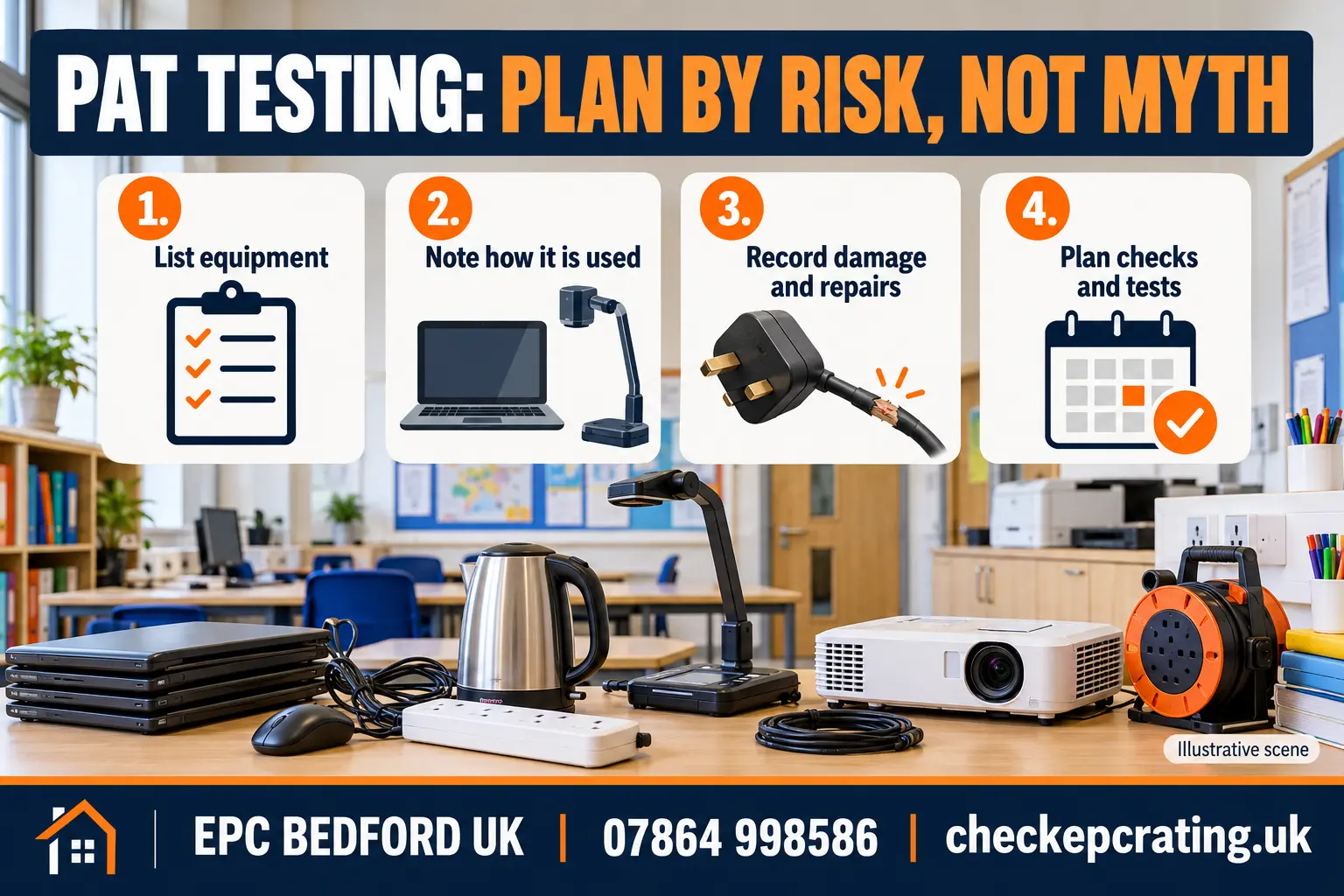
A sticker date is not a maintenance strategy. A useful school PAT plan starts with the equipment, how it is used and what its history is telling you.
Schools and institutions often have a complicated mix of laptops, kettles, projectors, extension leads, workshop tools, cleaning equipment and devices that move between rooms. Treating every item as identical can create unnecessary work while drawing attention away from equipment exposed to heavier use or damage.
A hypothetical term-time problem
Illustrative scenario: A fictional Bedfordshire school is preparing its premises for the autumn term. The office has a spreadsheet of last year's labels, but several classroom devices have moved, a floor cleaner has recently had a cable repair, and equipment brought in by departments is missing from the list.
This is not a customer story. It shows why repeating last year's list is not enough. The maintenance plan should reflect what is actually present, the environment, how often items move and any faults or repairs.
What the official guidance says
The Health and Safety Executive explains that portable appliance testing is the examination of electrical appliances and equipment to help ensure they are safe to use. Visual examination matters because some defects cannot be found by electrical testing alone. Depending on the equipment and its environment, user checks, formal visual inspection and combined inspection and testing may all have a place.
The law does not require every portable electrical appliance to receive a PAT test every year. HSE says the Electricity at Work Regulations 1989 require electrical equipment that could cause injury to be maintained in a safe condition, but they do not prescribe one universal method or frequency. Inspection and testing intervals should be based on the type of equipment, how it is used and the environment.
A four-step school PAT planning checklist
- Build a usable equipment list. Record the item, location or department, equipment type and an internal identifier. Include equipment that moves between rooms, is stored for part of the year or is brought into the workplace under the school's arrangements. Remove disposed items so the list remains manageable.
- Note how each item is used. A desktop monitor in a dry office is not exposed to the same conditions as a vacuum cleaner, extension lead or workshop tool. Consider movement, frequency of use, user group, environmental conditions and the likelihood of damage.
- Record defects, repairs and user reports. Frayed cables, damaged plugs, loose connections, heat damage and repeated repairs are useful warning signs. Unsafe equipment should be taken out of use and dealt with through the school's safety procedure; a future booking is not a reason to keep using visibly damaged equipment.
- Plan checks and tests around access. Group equipment sensibly, identify rooms with restricted access and agree how exceptions will be recorded. Holidays or planned access windows may reduce disruption, but scope, timing and attendance must be confirmed before relying on a date.
What to send when requesting a quote
Send the site postcode, approximate item count, building or room list, equipment mix, preferred access window and any existing register. Mention higher-use or regularly moved equipment and any known repair history. This helps define the likely scope without pretending that every item needs the same action.
For schools and institutions in Bedfordshire, Cambridgeshire and Hertfordshire, EPC Bedford UK can discuss planned site access and a scoped PAT testing enquiry. Actual coverage, equipment numbers, travel, access and availability are confirmed individually.
Short video: the four-step plan
Transcript: PAT testing in a school should be planned by risk, not by an annual myth. First, list the equipment. Second, note how and where each item is used. Third, record visible damage, faults and repairs. Fourth, plan user checks, visual inspection and testing at appropriate intervals. For a scoped school or institutional PAT enquiry, contact EPC Bedford UK on 07864 998586 or visit checkepcrating.uk.
Frequently asked questions
Does every appliance legally need annual PAT testing?
No. HSE states that the law does not require annual testing of every portable appliance. The approach and frequency should reflect the equipment, use, environment and risk.
Is a visual check enough?
Sometimes a trained user check or formal visual inspection is an important part of the regime, but certain defects require testing. The competent person should decide the appropriate combination and interval.
Should new equipment be tested immediately?
HSE says new equipment should be supplied in a safe condition and generally does not require a formal PAT immediately, although a simple visual check is recommended to confirm it has not been damaged.
Do items need labels and records?
HSE says labels and records are not legal requirements in themselves, but they can be useful management tools for monitoring the maintenance system and showing that a scheme exists.
Can school staff carry out user checks?
With suitable information or training, staff can carry out simple user checks. Formal combined inspection and testing requires greater knowledge, experience, appropriate equipment and the ability to interpret results.
What should happen to visibly damaged equipment?
Follow the organisation's safety procedure and prevent use where the item may be unsafe. Do not wait for a routine testing date before acting on obvious damage.
Is PAT testing the same as fixed-wire inspection?
No. PAT concerns portable or movable equipment. Inspection of the building's fixed electrical installation is a different activity and should be scoped separately.
Can several buildings be planned together?
Potentially. Provide building postcodes, approximate item counts, equipment mix and access windows so the work can be scoped. Attendance and timing must still be confirmed.
Is your equipment list ready for a practical risk-based plan?
Send the site postcode, approximate item count, equipment mix and preferred access window to request a scoped PAT testing quote for a school, workplace or institution.
Request a PAT quoteCall 07864 998586
WhatsApp 07864 998586 · checkepcrating.uk
Related: PAT testing in Bedford · how often should equipment be inspected or tested? · PAT testing and fixed-wire testing compared.
Official sources: HSE PAT testing FAQs and HSE guidance for low-risk environments.